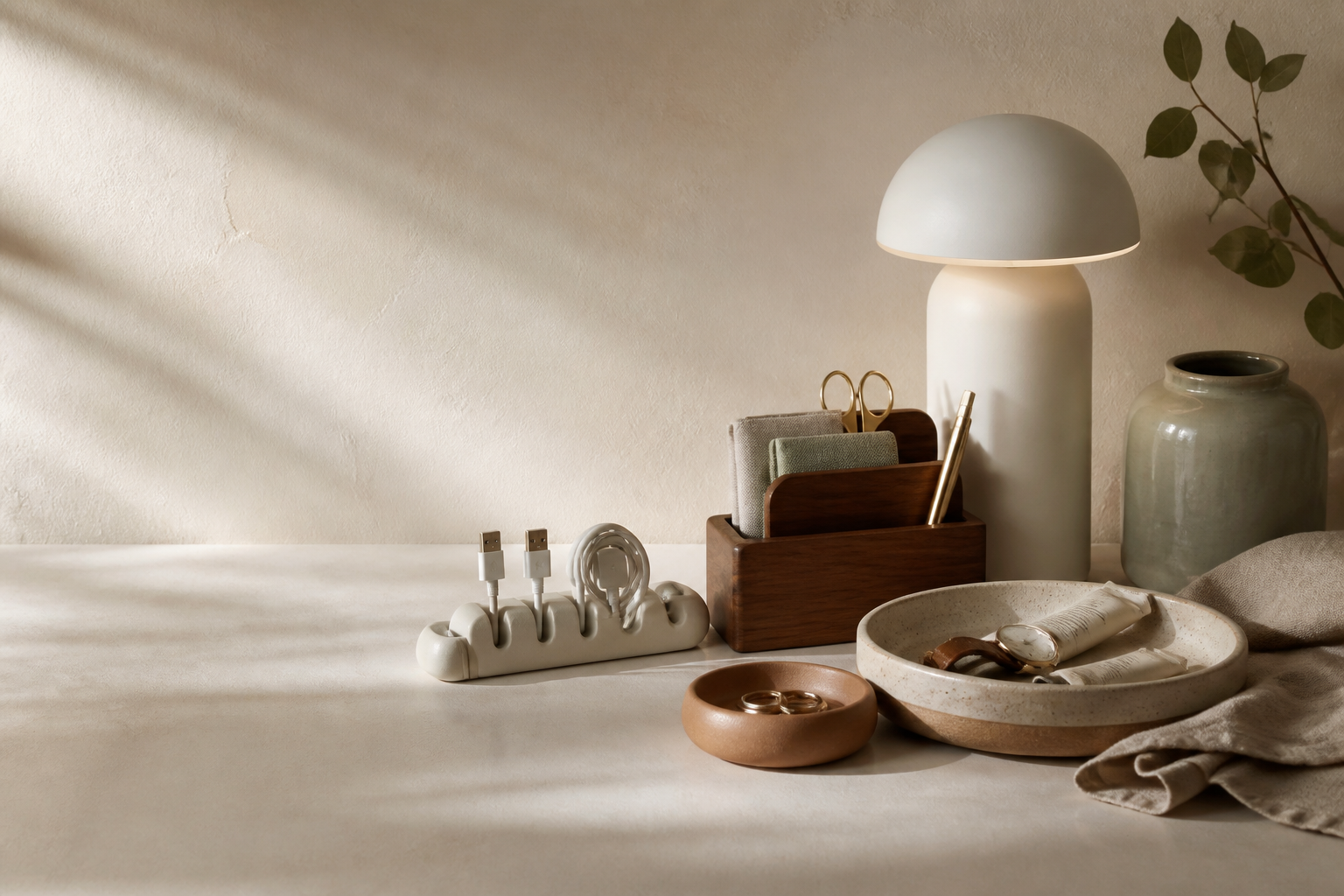

The internet has no shortage of things to look at, save, compare, and buy. The harder question is what deserves your attention in the first place.
A beautiful photograph does not always mean an object is practical. Something popular may not fit your routine. The least expensive option is not automatically the best value, and a higher price does not make something right for everyone.
That is where curation can help. Found for You is meant to be a useful filter: a place to start when you want fewer options and a clearer reason to consider them.
We are not trying to declare one universal best choice. We want to explain why something may be worth a closer look—and to be honest when it may not be the right fit.
Useful first
Usefulness does not have to mean essential. A find may solve a small annoyance, simplify a repeated routine, make an awkward space easier to use, or add genuine comfort to something you already do.
That might mean a cable organizer that keeps a charging area reachable, a travel organizer that makes a bag easier to repack, or a reading light that lets a comfortable corner work after dark. The object does not need to transform your life. It does need a reason to exist in the recommendation.
We look for the problem, pleasure, or practical improvement first. A good photograph can invite attention, but usefulness is what gives that attention somewhere to go.
Good value
Good value is not the same as the lowest price. Sometimes an inexpensive option is exactly enough. Sometimes paying a little more makes sense because of the materials, construction, functionality, size, comfort, versatility, included features, or ease of use.
The important question is what you are getting for the price—not whether the number is the smallest one available. We consider whether the cost feels legible for the intended use, while leaving room for different budgets and priorities.
Value is personal and contextual. A compact solution may be worth more to someone with very little space, while another person may care most about simplicity or flexibility. We try to make that tradeoff visible rather than presenting price as a verdict.
Thoughtful design
Design can be beautiful, but it should contribute something beyond the photograph. Good design may make an object easier to use, easier to store, more comfortable to handle, calmer to look at, or simpler to integrate into everyday life.
For Style, that might show up in proportion, versatility, wearability, or how easily a piece works with clothes you already own. For Home & Living, it may be function, storage, accessibility, or footprint. For Books & Gifts, it can be usability, experience, presentation, or thoughtfulness.
A visually appealing item can absolutely be worth sharing. We simply want the appeal to have a practical or experiential dimension too.
Real-life fit
An idea can look brilliant in a styled photograph, an advertisement, or a perfectly organized home and still be inconvenient in normal life. Where would it actually live? How much room would it take? Would someone realistically use it?
We also consider whether it requires more maintenance than the problem it solves, whether it fits the intended situation, and whether it requires several other purchases before it becomes useful. Sometimes a simpler solution is the better find.
A clever idea is not automatically a useful idea. Found for You should never imply that every problem requires another product. Sometimes the most helpful conclusion is realizing that you may not need to buy anything at all.

Information over hype
When we evaluate a product or idea, relevant information can include specifications, dimensions, materials, features, intended use, compatibility, available options, and meaningful price differences. Comparisons with similar choices can help too.
Customer feedback may offer another useful signal, especially when the same theme appears repeatedly. A pattern of comments about sizing, assembly, unexpectedly small dimensions, or a particularly useful feature may be worth noticing.
Reviews are one source of information, not an infallible answer. Ratings alone should not determine whether something is worth recommending. Context matters, and limitations matter too.
Transparency
We want to be clear about what we know and what we do not. If a product has not been personally used, it should not be described as though it has. Accurate language matters more than sounding enthusiastic.
That means avoiding phrases such as “we love this,” “we tested this,” or “our favorite” unless they are genuinely true. A recommendation can instead be based on research, comparison, specifications, available information, recurring customer-feedback themes, and how well it appears to suit the problem being discussed.
No recommendation is universally right. People differ in budget, taste, body, home, available space, lifestyle, priorities, and needs. The goal is to offer a better starting point for making your own decision—not to make it for you.
The Found for You Test
Before something earns a place in this collection, these are the questions worth asking:
- Does it solve a real problem or add genuine enjoyment?
- Does it offer reasonable value for what it provides?
- Does the design make sense beyond the photograph?
- Can we explain why it is worth considering?
- Can we describe it accurately without exaggerating?
If we cannot answer those questions clearly, it probably does not need to be a Found for You find.
A filter, not a promise of perfection
Found for You Co. does not exist to declare one universal “best” product. One reader may care most about price. Another may care about space, appearance, simplicity, durability, or convenience.
Our job is to narrow the noise and explain why something may be worth considering. There will always be more things to scroll through, compare, and buy. We would rather share fewer things with a reason behind them.
The good stuff, already found.