
Many kitchens do not necessarily lack storage altogether. The problem is that the storage they have is often awkward, inefficient, overcrowded, or poorly matched to the things they actually own.
A cabinet can technically have room while still being almost impossible to use. A drawer can be full without containing anything you can easily find. And food-storage containers somehow seem capable of taking over an entire cabinet while their matching lids disappear.
Good organization is not about making a kitchen look perfect. It is about creating usable space, reducing everyday frustration, and making the things you already own easier to find and easier to put away.
That can mean using cabinet height more intentionally, creating a better place for temporary things, or simply removing the objects that no longer serve a purpose.
The goal is not to make every surface empty or every shelf photograph-ready. It is to help a limited kitchen work more naturally for the people who use it.
Here are ten practical places to begin.
Finally tame the plastic-container-and-lid chaos
Food-storage containers are useful, but they are also one of the fastest ways for a kitchen cabinet to become unmanageable.
The goal is not to build an elaborate system. It is to make the containers you use most often easy to see, match, and put away.
Start by taking everything out and pairing lids with bases. Set aside cracked containers, warped lids, and pieces that have been waiting for a match for too long.
Then consider a simpler arrangement:
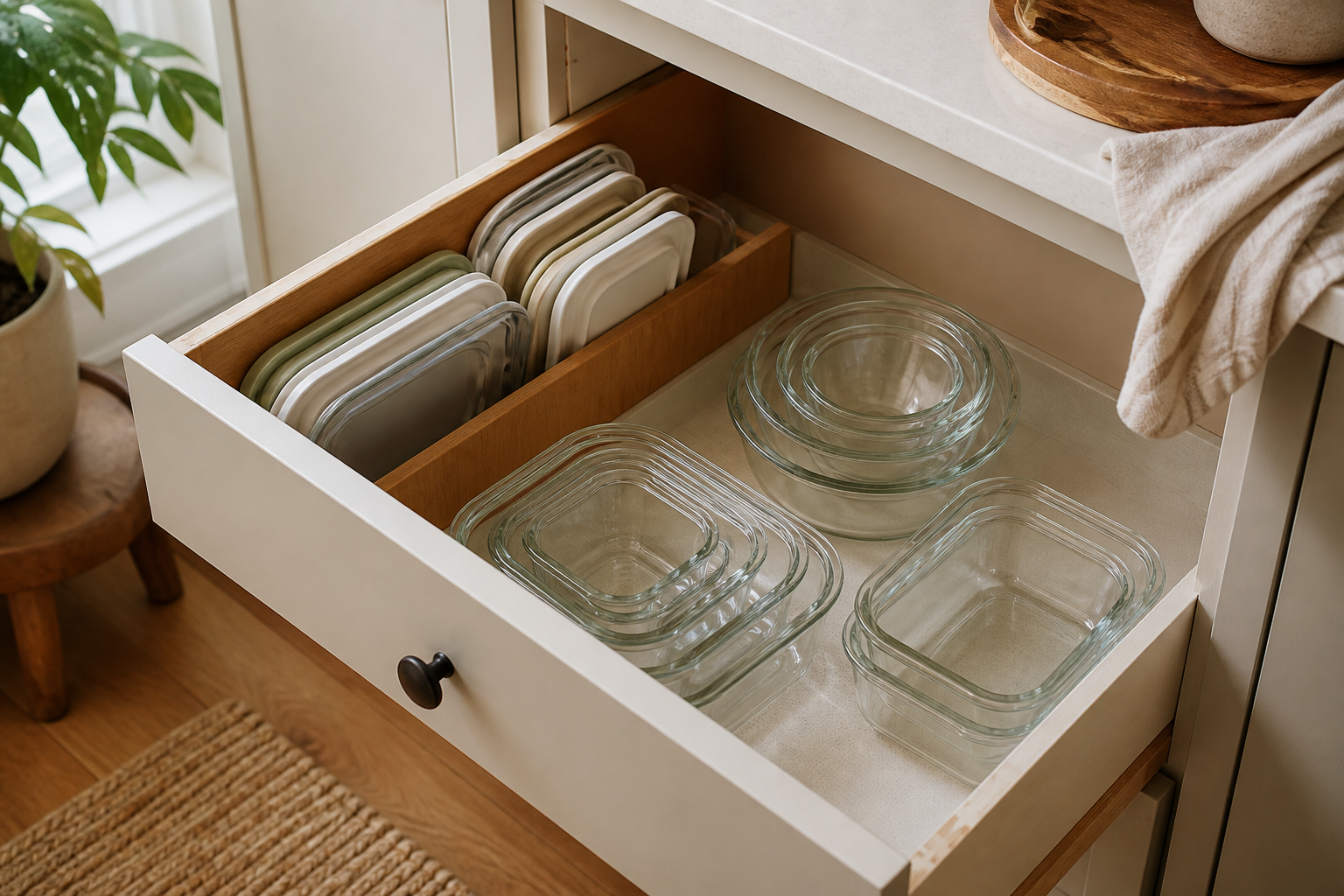
- nest containers by size where possible
- store lids vertically in a shallow bin or divider
- keep the most-used sizes at the front of the cabinet
- group glass and plastic separately if that makes the collection easier to scan
- revisit the group periodically and remove orphaned pieces
A little separation can create more usable space than another stack of containers.
Create more space without adding another cabinet
When a cabinet feels full, look up before looking for somewhere else to put things.
Many shelves have unused air above shorter objects. Shelf risers, under-shelf baskets, stackable bins, and slim vertical dividers can turn that empty height into useful storage without changing the cabinet itself.
This works particularly well for mugs, small bowls, plates, baking supplies, pantry items, or the things that tend to collect in a single crowded stack.
Before adding anything, measure the shelf height and the objects that need to fit. The best addition creates a second level without making either level difficult to reach.
- use a riser for short stacks of plates or bowls
- add a shallow basket beneath a shelf for packets and small supplies
- stand baking sheets and boards vertically instead of stacking them flat
- keep a little breathing room so the cabinet remains easy to reset
Get bulky pots, pans, and lids under control
Cookware takes up a lot of space because it is heavy, irregularly shaped, and usually used often enough that hiding it behind a stack is frustrating.
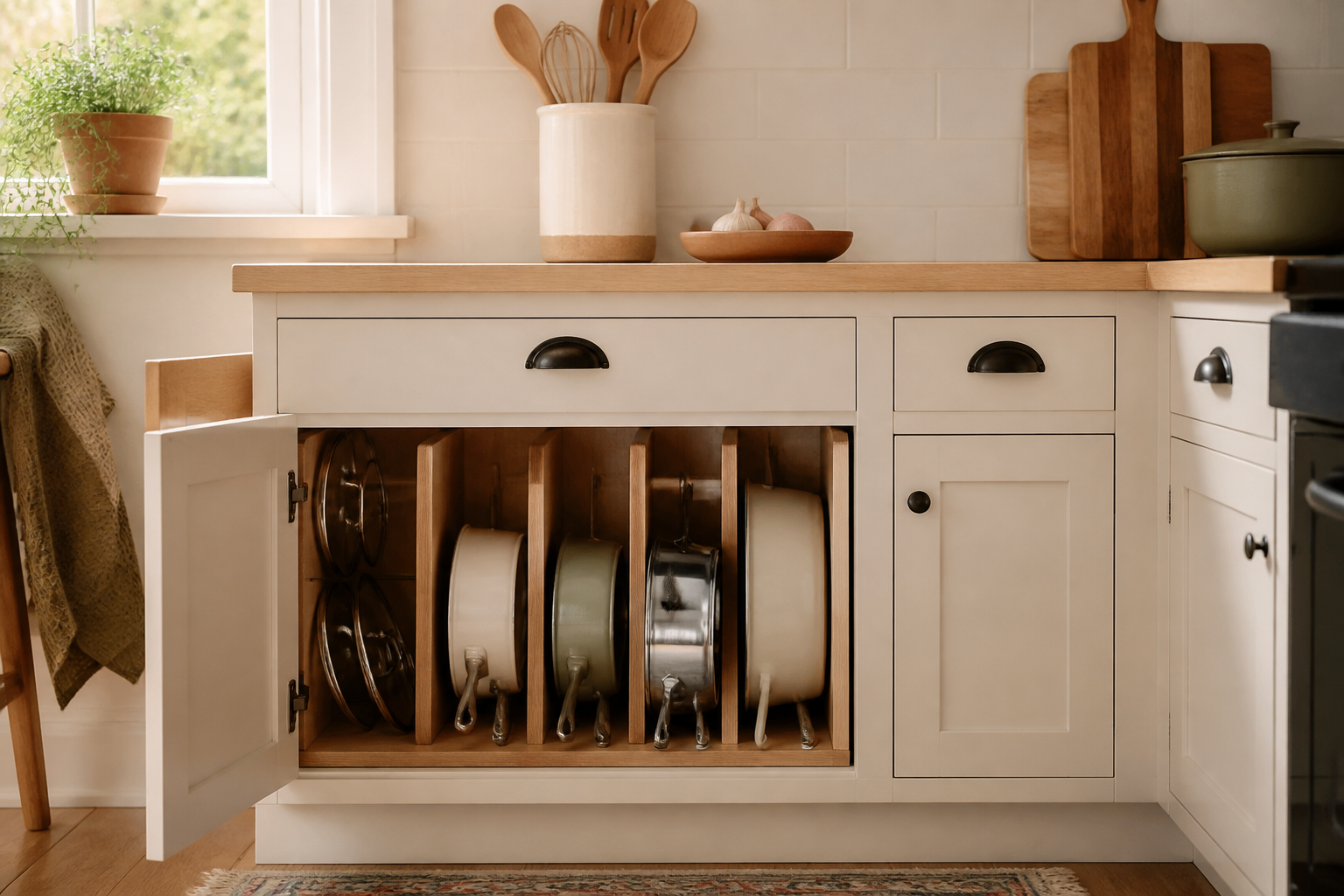
If possible, store pans vertically with sturdy dividers so each one can be lifted out on its own. Keep lids close by, but give them a separate position rather than allowing them to slide between the pans.
For deeper cabinets, a pull-out shelf or a stable, easy-to-reach arrangement can be more useful than maximizing every last inch. A system that asks you to unload half the cabinet is not saving much time.
Keep the pieces you reach for most often in the easiest position, even if that means storing occasional-use cookware somewhere less convenient.
- stand pans and baking sheets on edge with dividers
- use a dedicated slot or rack for lids
- stack only pieces that nest securely and are used together
- store heavier items where they can be lifted safely
Free the countertop from everyday clutter
A kitchen countertop does not need to be empty to feel calm. It does need to support the way you actually use the room.
Start by separating the things that earn their place from the things that have simply landed there. Appliances used several times a day may deserve a permanent position. Everything else might work better in a nearby cabinet, drawer, or temporary landing zone.
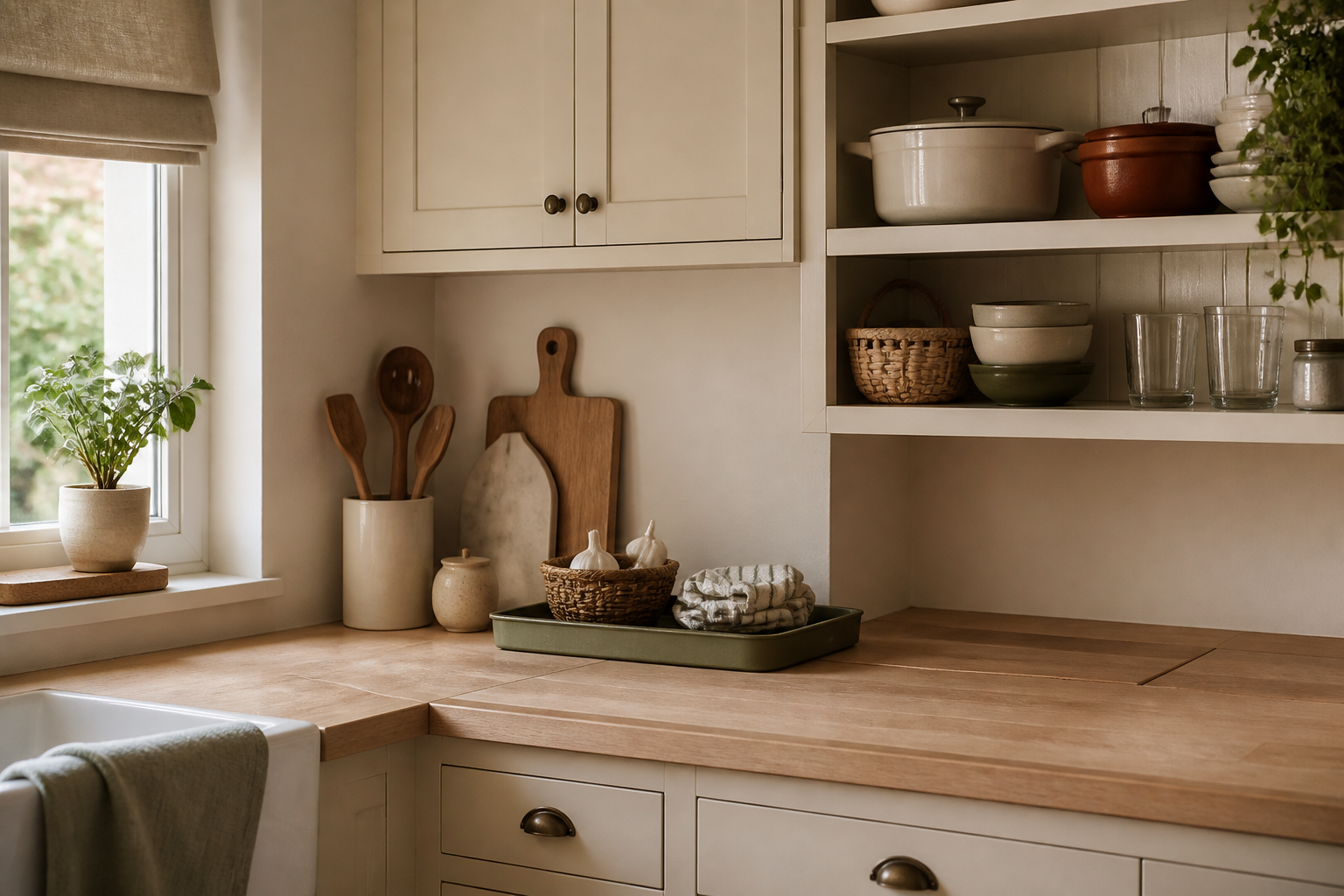
A tray can gather oils, seasonings, or coffee-making essentials without allowing them to spread. A wall rail, narrow shelf, or utensil crock can move a few frequently used tools upward and off the work surface.
Leave the most valuable counter area available for preparation, serving, and the tasks that change from day to day.
Usually worth keeping close:
- the tools you use daily
- one compact group of cooking oils or seasonings
- a small landing place for items in active use
Usually worth relocating:
- duplicates
- rarely used appliances
- mail, bags, and objects waiting to leave the kitchen
Make the dreaded under-sink cabinet actually usable
The space under the sink is rarely straightforward. Plumbing, awkward corners, and limited light can make it feel like a place where useful things go to disappear.
A low pull-out bin or two compact handled containers can make the cabinet easier to see and reach. Group similar supplies together, but keep the arrangement flexible around the pipes rather than forcing a perfectly symmetrical setup.
Store products in their original containers and follow their storage instructions. Leave plumbing, shutoff points, ventilation, and any electrical access clear, and avoid placing anything where a small leak would damage it immediately.
The best improvement here is visibility: if you can see what you have, you are less likely to buy duplicates or forget what is at the back.
- use low bins that can be lifted out easily
- keep cleaning cloths and brushes in a separate, reachable group
- leave a clear path to plumbing and shutoff points
- check the cabinet occasionally for leaks or dampness
Find a better home for water bottles, tumblers, and travel mugs
Tall drinkware is often too large for standard shelves and too useful to bury at the back. The result is a leaning collection that falls over whenever one bottle is removed.
Choose a single zone for bottles, tumblers, and travel mugs, then separate the pieces from their lids, straws, and handles only if that makes them easier to return. A vertical rack can help, but a simple row in a lower cabinet may be enough.
Keep the items used every day within easy reach. Seasonal bottles, specialty cups, and duplicates can move higher or farther back so the prime space supports the routine rather than the entire collection.
- store tall pieces upright where possible
- group lids or small parts in one shallow container
- use a divider to stop bottles from tipping into one another
- remove pieces that leak, no longer fit your routine, or are never chosen
Stop losing food at the back of the pantry and refrigerator
Organization is difficult to maintain when you cannot see what you own. A crowded shelf encourages forgotten ingredients, duplicate purchases, and a constant search through the same few inches of space.
Create loose zones instead of trying to make every item perfectly uniform. Keep breakfast items together, group baking ingredients, give snacks a defined area, and place the things you use most often where your eyes naturally land.
Bins, turntables, and shallow pull-out drawers can help with deep shelves. You do not need to decant everything into matching containers; labels and original packaging are often more useful when they remain easy to identify.
As new food comes in, move older items forward. That small habit does more for visibility than a complicated pantry makeover.
- use shallow bins for small packets and loose items
- keep taller containers toward the back where they remain visible
- place soon-to-be-used food at the front
- avoid filling shelves so tightly that nothing can be removed cleanly
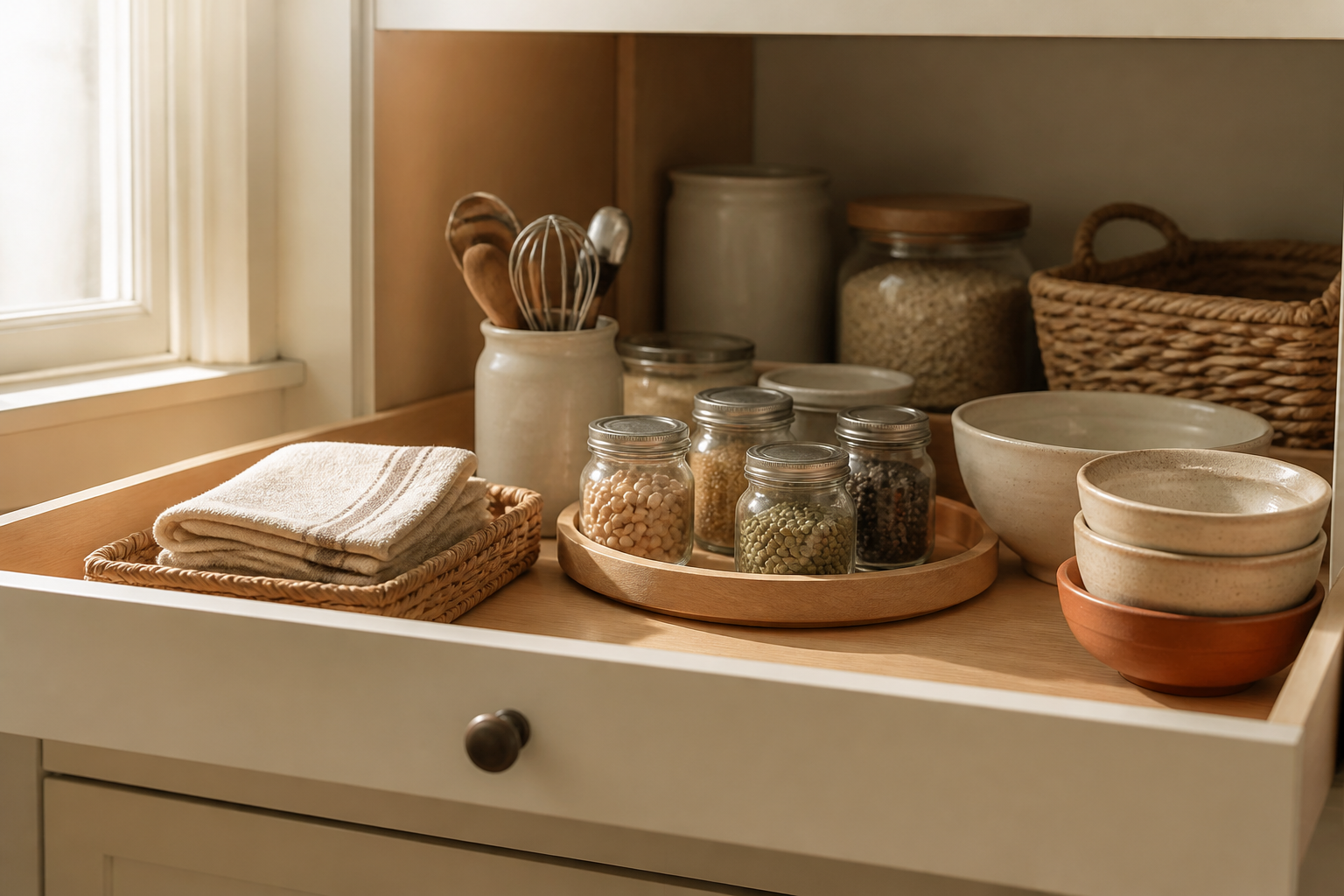
Deal with the awkward little things that never seem to have a home
Funnels, clips, trivets, reusable bags, thermometers, spare attachments, and small tools can create more visual noise than their size suggests.
These objects need a defined category, not necessarily a separate organizer for every item. A divided drawer, one shallow bin, or a few labeled sections can keep them together without making the system feel overbuilt.
When sorting, ask whether each piece belongs to a task you actually do. If an object only makes sense as part of a set, keep it with that set. If it has been waiting for a use for years, it may be taking up more mental space than practical space.
- group small tools by the task they support
- keep attachments with the appliance or tool they belong to
- use one flexible container rather than many tiny compartments
- let go of duplicates and pieces without a clear purpose
Make one overloaded drawer work much harder
The drawer that holds everything is often a sign that the kitchen needs a little editing, not a bigger drawer.
Empty it completely and sort the contents into broad groups. Put everyday tools together, move occasional-use pieces elsewhere, and remove anything broken, duplicated, or unrelated to the kitchen.
Then use dividers only where they solve a real problem. A little space around each group makes the drawer easier to scan and gives objects somewhere to return after they are used.
If the drawer is still full, resist the temptation to pack it more tightly. A drawer that closes is not necessarily a drawer that works.
- start with a blank drawer
- organize by frequency and task
- keep the most-used tools toward the front
- leave enough space to remove one item without disturbing everything else
Create a home for things that are always coming and going
Reusable shopping bags, lunch containers, grocery lists, delivery packaging, and items waiting to be returned often gather in the kitchen because it is the last stop before they leave the house.
Give these transitional things a temporary home near the door, on the back of a pantry door, or in one clearly defined basket. The point is not permanent storage. It is a reliable place for objects that are between tasks.
Keep the zone small enough that it cannot become a second miscellaneous closet. When the basket is full, that is a useful signal to return, recycle, donate, or move what is inside.
This kind of landing place can make the kitchen feel calmer without pretending that everyday life is perfectly static.
- choose one visible, easy-to-reach landing zone
- separate clean reusable bags from items waiting to leave
- set a simple reset point once a week
- keep the zone contained so it does not spread across the counter
Organize around the way you actually cook
Good kitchen organization is not about owning more organizers.
It is not about transferring every ingredient into matching containers or making every cabinet photograph-ready.
A useful system should make everyday kitchen tasks easier.
Before changing anything, ask:
- What creates the most frustration in my kitchen?
- Which cabinet or drawer is hardest to use?
- What do I reach for most often?
- What am I constantly moving out of the way?
- What do I repeatedly lose?
- Which things are taking up space without being used?
- Is there unused vertical or hidden space I could use better?
Sometimes the biggest improvement does not come from adding more storage.
It comes from making the storage you already have work better.